

You don’t casually decide to climb Nanga Parbat.
This is not a mountain you stumble upon while browsing bucket lists. This is a mountain you study. Respect. And approach with intent.
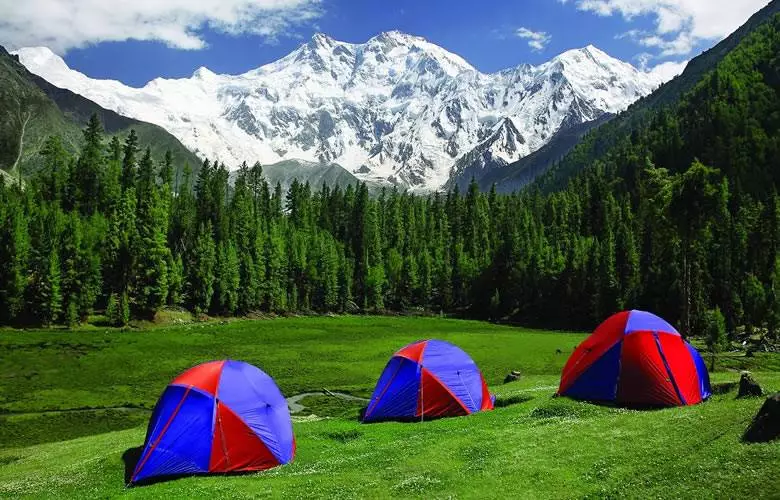
The Nanga Parbat Expedition is one of the most demanding undertakings in high-altitude mountaineering. At 8,126 meters, Nanga Parbat stands as the ninth-highest peak on Earth and the westernmost giant of the Himalayan range. It rises alone. Steep. Abrupt. Unforgiving.
And it carries a name that stops people mid-sentence:
The Killer Mountain.
Before you think about routes, permits, or summit days, you need to understand why this mountain earned that reputation and why climbers still line up to face it.
What Is the Nanga Parbat Expedition and Why Is It Called the Killer Mountain?
The Nanga Parbat Expedition is not just a climb.
It is a confrontation with geography, weather, and history.
Located in the Diamer District of Gilgit-Baltistan, Pakistan, Nanga Parbat rises dramatically from the Indus Valley. In just 25 kilometers, the mountain gains nearly 7,000 vertical meters. That vertical relief is almost unmatched in the Himalayas.
Unlike Everest or Cho Oyu, Nanga Parbat does not sit deep inside a mountain chain. It stands apart. That isolation gives it its own weather system volatile snowfall, sudden storms, and relentless avalanche cycles.
Even today, with fixed ropes on the standard route, the summit success rate hovers around 30%. Objective hazards remain constant. Rockfall. Serac collapse. Whiteout storms.
This is why the Nanga Parbat Expedition sits in a different category than most commercial 8000-meter climbs.
The Etymology of the “Killer Mountain”
The nickname did not come from marketing.
Locally, the mountain is called Diamir, meaning King of the Mountains.
The name Nanga Parbat comes from Sanskrit and Urdu, translating to “Naked Mountain.” Its ridges shed snow. Bare rock dominates the upper faces.
But Western climbers gave it another name.
Schicksalsberg.
The Mountain of Destiny.
Before its first ascent in 1953, 31 climbers and porters died on its slopes. No other 8000-meter peak had claimed so many lives before being climbed.
The mountain did not forgive mistakes. And it still doesn’t.
Why Is Nanga Parbat Known as the Killer Mountain?
Nanga Parbat’s lethality comes from specific, repeatable factors, not myth.
The Historical Catalog of Attrition
Early expeditions focused on the Rakhiot Face, a route that looks logical on maps and lethal in reality.
- 1895 – The Mummery Disappearance
Albert F. Mummery reached 6,100 meters before attempting a traverse. He and two companions vanished. Likely avalanche victims. They were the mountain’s first casualties. - 1934 – The Merkl Disaster
A German expedition became trapped by storms near the Silver Saddle. Ten climbers died during a slow retreat. Exhaustion. Exposure. No rescue. - 1937 – The Wien Catastrophe
A massive ice avalanche destroyed Camp IV on the Rakhiot Face. Sixteen climbers died in seconds. This single event cemented Nanga Parbat’s reputation as unpredictable and merciless.
Modern Mortality Statistics
Technology reduced risk. It did not erase it.
- Approximate ascents: 339
- Approximate deaths: 69
- Fatality-to-summit ratio: ~21%
That places Nanga Parbat in the same lethal tier as K2 and Annapurna.
Even in 2025, experienced climbers continue to die during descents often after successful summits. On this mountain, survival is never guaranteed once you turn around.
What Makes the 8126m Peak Technically Dangerous?
Nanga Parbat does not kill because it is tall.
It kills because of how it is built.
1. Extreme Vertical Relief and Steepness
From Base Camp to summit, climbers gain nearly 4,000 vertical meters on the Diamir Face. There are no long plateaus. No rest highways.
Angles remain 40° to 60° for days.
On the Rupal Face, the wall rises 4,600 meters the highest continuous mountain face on Earth.
2. Avalanche and Serac Hazard
Nanga Parbat acts as a moisture barrier for air masses moving north from the plains of Pakistan. Snow loads build fast. Stability disappears faster.
- The Diamir Face funnels avalanches into the Bazhin Basin.
- The Rakhiot Face hangs beneath massive seracs capable of releasing millions of tons of ice.
3. Technical Climbing at Altitude: The Kinshofer Wall
Unlike Everest’s South Col, Nanga Parbat requires real climbing.
- UIAA IV/V rock
- WI4 ice
- All above 6,000 meters
The Kinshofer Wall forces climbers to jumar steep limestone while wearing down suits, crampons, and heavy packs. Fatigue accumulates early.
4. The Death Zone Duration
Summit day often lasts 12–18 hours.
Camp 4 sits around 7,400 meters. From there, climbers traverse, climb the final pyramid, and descend the same day. Exposure above 8,000 meters is prolonged.
Mistakes compound fast.
Which Route Is Best: Diamir Face or Rupal Face?
For 2026 climbers, this decision is straightforward.
The Diamir Face (West)
Status: Standard commercial route
Traffic: Over 95% of attempts
Route: Kinshofer Route
Pros
- Shorter approach
- Fixed ropes
- Shared rescue infrastructure
- Avoids Rupal’s massive vertical wall
Cons
- Rockfall in lower couloirs
- Avalanche exposure in upper basins
- Technical crux early in the climb
The Rupal Face (South)
Status: Elite, alpine-style only
Traffic: Extremely low
This is the world’s highest mountain face. Retreat is difficult. Weather windows are unforgiving. This route is for climbers seeking historical impact not commercial summits.
The Rakhiot Face (North)
Status: Historical
Traffic: Almost none
Too long. Too exposed. Too inefficient.
Verdict:
For a realistic Nanga Parbat Expedition in 2026, the Diamir Face via the Kinshofer Route is the only logical choice.
Why Do Climbers Choose the Kinshofer Route?
Because it balances danger with predictability.
Established in 1962, the Kinshofer Route bypasses the most active avalanche paths and follows a rock buttress along the Diamir Face.
Route Breakdown and Technical Profile
Base Camp to Camp 1 (4,200m–4,900m)
Glacier travel. Crevasses. Serac zones.
Camp 1 to Camp 2 – The Kinshofer Wall (4,900m–6,100m)
The technical crux. A near-vertical limestone wall fixed with static ropes. Camp 2 sits exposed on a narrow ridge.
Camp 2 to Camp 3 (6,100m–6,800m)
Steep snowfields. No rest angles. Pure endurance.
Camp 3 to Camp 4 – Bazhin Basin (6,800m–7,400m)
High. Flat. Dangerous. This is the summit launchpad.
Summit Push (7,400m–8,126m)
Traverse. Final pyramid. Sharp summit ridge. Long descent.
Climbers choose this route because the hazards are known, not because they are mild.
Who First Climbed Nanga Parbat?
The answer still sounds unreal.
The 1953 Austro-German Expedition
Led by Karl Herrligkoffer, the expedition aimed to settle decades of failure. Internal conflict plagued the team. Orders were rigid. Morale was low.
Then Hermann Buhl broke the rules.
Hermann Buhl’s Solo Masterpiece
On July 3, 1953, Buhl launched a summit bid alone from 6,900 meters.
He climbed for 17 hours.
Reached the summit at 7:00 PM.
Then descended into darkness.
Forced to bivouac at nearly 8,000 meters, standing on a tiny ledge, Buhl survived the night without a tent or sleeping bag. He hallucinated. Froze. Endured.
Forty-one hours later, he returned alive.
It remains the only solo first ascent of an 8,000-meter peak.
What Permits Does the Ministry of Tourism Require?
This is where many expeditions fail before they begin.
Authority Structure
Permits are issued by the Gilgit-Baltistan Department of Tourism, not directly by Islamabad. Applications must go through a licensed Pakistani tour operator.
Liaison Officer Requirement
Every foreign expedition must host a Liaison Officer.
You must provide equipment, food, accommodation, and allowances.
Mandatory Insurance (New Enforcement)
- High-altitude porter insurance: PKR 3 million coverage
- Climber insurance: Must cover helicopter rescue above 6,000 meters
Permits will not be issued without proof.
Is the Nanga Parbat Expedition Right for You?
This is not a stepping-stone mountain.
You need:
- Technical ice and mixed climbing experience
- Comfort on steep terrain at extreme altitude
- Psychological resilience
- Respect for a mountain that punishes complacency
But if you’re prepared properly Nanga Parbat offers something few mountains do.
Purity.
History.
And a summit that still means something.
If you want this expedition handled by professionals who understand the Kinshofer Route, the permit system, and the realities of climbing the Killer Mountain, the next step is simple.
This is where planning turns into commitment.
And commitment is what Nanga Parbat demands.